The Black Strat made 20% a year. Don’t try this at home
David Gilmour’s guitar sold for $3.975mn in 2019 and $14.56mn this year. With Johnny Marr’s collection tripling its estimate last week, rock guitars have become trophy assets.
In June 2019 David Gilmour sold the Black Strat, the Fender Stratocaster he played on The Dark Side of the Moon, at a charity auction in New York. The buyer was Jim Irsay, the owner of the Indianapolis Colts, who paid $3.975mn, then a record for any guitar.
Irsay died in 2025. This year Christie’s sold his collection, and the Black Strat went for $14.56mn.
That is a return of about 3.7 times in seven years, or roughly 20 per cent a year compounded, on an asset that pays no dividend and has to be kept at the right humidity. Anyone selling guitars as an investment will be quoting it for years. Repeating it is another matter.
A record season
The Irsay sales, which ran from March to 1 July, raised about $105mn from 406 lots, the highest total ever achieved by a memorabilia collection. The top prices read like a history of 20th-century popular culture: Jack Kerouac’s scroll typescript of On the Road at $12.1mn, Jerry Garcia’s “Tiger” guitar at $11.6mn, the Fender Mustang that Kurt Cobain played in the “Smells Like Teen Spirit” video at $6.9mn, and Eric Clapton’s Unplugged Martin at $4.1mn.
At the other end of the catalogue, a set of Soviet uniform epaulettes sold for $254.
Last week the season acquired a coda. On 17 September Christie’s in London sold Marr’s Guitars: The Johnny Marr Collection, instruments owned and played by the former guitarist of the Smiths. Bidders from 34 countries took the total to £3,649,280, more than triple the estimate.
Marr’s 1982 Rickenbacker 330 in Jetglo black, the guitar most associated with the band, carried an estimate of £60,000 to £80,000 and sold for £358,400. The 1971 Martin D-28 on which he wrote much of the Smiths’ catalogue was estimated at £30,000 to £50,000 and made £128,000.
Proceeds from 31 lots went to the Guide Dogs for the Blind Association and the National Autistic Society.
Doing the sums
The 20 per cent figure is before costs. Auction houses charge buyers a premium on top of the hammer price and charge sellers commission; insurance and specialist storage add more. Nobody keeps an index of stage-played guitars that sold for less than their owners paid, though there are plenty of them.
The Black Strat’s value also has very little to do with the guitar itself. An ordinary Stratocaster of the same age sells for a small fraction of the price. Collectors are paying for provenance, the documented proof that this object was on stage and in the studio with Gilmour for half a century, and only a handful of instruments in the world have a history like that.
Most of them are already in private hands.
Who sells
The big guitar sales of recent years have mostly come from musicians clearing out, often for charity, or from collectors’ estates. Gilmour sold to fund the environmental law charity ClientEarth. Irsay’s collection was sold after his death, and Marr gave away the proceeds of part of his sale.
Sales like these come with publicity built in, and bidders know the instruments may not come up again for decades.
The demand underneath is real enough. People who grew up on Pink Floyd, the Grateful Dead and the Smiths now control a lot of money, and some of them would rather hang a guitar from a record they love than another painting.
Irsay, who once claimed to have turned down $1bn for his collection, got there early. Buyers this year paid prices that assume everyone else has caught up.
Sources
- Jim Irsay’s $105mn record-breaking collection: all 406 items and what they sold for
- Wikipedia: The Black Strat
- ITV News: Johnny Marr’s guitars sell for £3.6mn (18 Sep 2026)
- Guitar.com: Johnny Marr guitar auction brings in £3.6mn
- The Irish Times: Johnny Marr guitar collection sells at auction
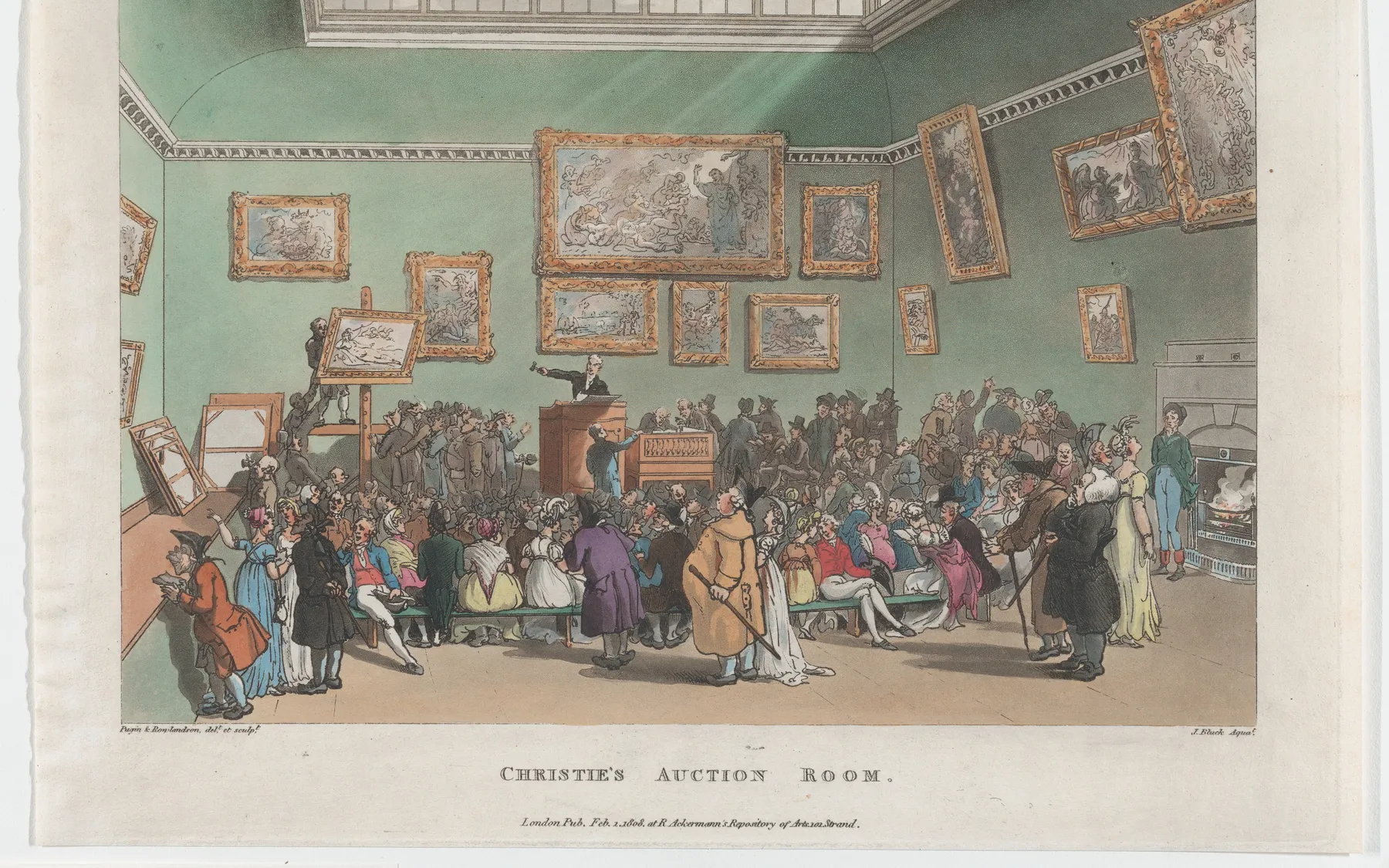
The annual return is calculated from the two published sale prices over seven years, before costs. Cover image: Christie’s Auction Room by Thomas Rowlandson and Augustus Charles Pugin, published by Rudolph Ackermann, 1808, Metropolitan Museum of Art via Wikimedia Commons, CC0. Cropped.

More from OutBragger
View all OB / 01
Six figures to walk in: 2026 repriced the world’s scarcest seats
The Met Gala broke $100,000 a ticket, Wimbledon’s best seats cost £116,000 for five years, and FIFA let the price of the World Cup final float. The people who run exclusive events have stopped leaving money on the table.
 OB / 02
Europe’s great inheritance fights are being settled in Swiss villages and Hong Kong banks
The Agnelli, Delon, Hermès and Wahaha fortunes are all tied up in court. In each case the argument turns on a Swiss address, a Swiss will or a Hong Kong trust.
 OB / 03
Paramount’s new owners inherited a $400mn tax argument from Viacom
The IRS has proposed up to $400mn in extra tax on Viacom’s returns for 2017 to 2019. Paramount Skydance says it disagrees and will book any change in its third-quarter results.
Discussion
Join this article’s en edition thread. Replies in other language editions stay separate.